

4 He will judge between the nations
and will settle disputes for many peoples.
They will beat their swords into plowshares
and their spears into pruning hooks.
Nation will not take up sword against nation,
nor will they train for war anymore.
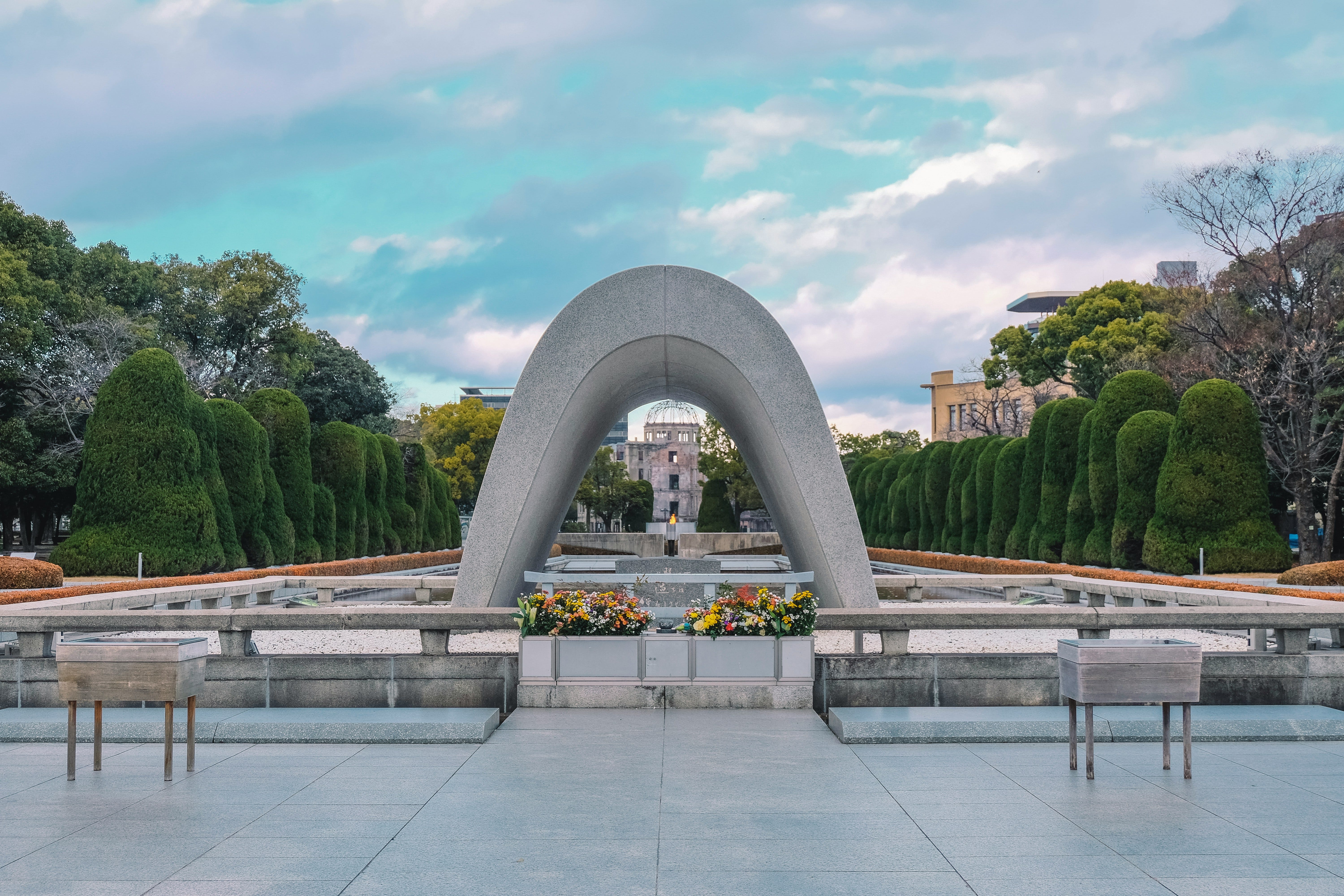
Hiroshima, Wednesday, February 25, 1981
War is the work of man. War is the destruction of human life. War is death.
Nowhere do these truths impose themselves on us more forcefully than in this city of Hiroshima, at this Peace Memorial. Two cities will forever have their names joined together, two Japanese cities, Hiroshima and Nagasaki, as the only cities in the world that have had the misfortune of standing as a warning that man is capable of destruction beyond belief. Their names will always remain the names of the only cities of our time singled out as a warning to future generations that war can destroy humanity’s efforts to build a world of peace.
Mr. Mayor, dear friends present here, and all who hear my voice and whom my message will reach:
1. I have come here today with deep emotion as a pilgrim of peace. I have wished to make this visit to the Hiroshima Peace Memorial out of the profound personal conviction that to remember the past is to commit oneself to the future.
Together we remember that it is one of humanity’s sad achievements that across the face of the earth the names of so many—too many—places are remembered chiefly because they have witnessed the horror and suffering produced by war: war memorials that, while commemorating the victory of one side, also recall the suffering and death of countless human beings; cemeteries where those who sacrificed their lives in the service of their country or of a noble cause rest, and cemeteries where the innocent civilian victims of war’s destructive fury lie; the memories of concentration and extermination camps, where contempt for man and his inviolable rights reached its lowest and cruelest expression; battlefields where nature has mercifully healed the scars of the earth, yet without being able to erase the human history of a past of hatred and enmity. Hiroshima and Nagasaki stand out above all other places and monuments as the first victims of nuclear war.
I bow my head as I recall the thousands of men, women, and children who lost their lives in that terrible moment, or who for many years carried in their bodies and minds those seeds of death that inexorably continued their process of destruction. The final toll of human suffering that began here has not been fully assessed, nor has the total human cost been calculated, especially when we consider what nuclear war has produced—and may still produce—in our ideas, our attitudes, and our civilization.
2. To remember the past is to commit oneself to the future. I cannot but honor and applaud the wise decision of the authorities of this city that the memorial of the first nuclear bomb should be a monument to peace. In doing so, the city of Hiroshima and all the people of Japan have powerfully expressed their hope for a peaceful world and their conviction that the man who makes war can also successfully build peace. From this city, and from the events its name recalls, there has arisen a new world consciousness against war, and a vigorous determination to work for peace.
Some people, even among those who were alive at the time of the events we remember today, might prefer not to think about the horror of nuclear war and its dreadful consequences. Among those who have never personally experienced the reality of armed conflict between nations, some would like to dismiss the real possibility of nuclear war. Others would wish to regard nuclear capability as an unavoidable instrument for maintaining a balance of power through a balance of terror. But there is no justification for not raising the question of the responsibility of every nation and every individual in the face of possible wars and the nuclear threat.
3. To remember the past is to commit oneself to the future. I call before you the memory of August 6, 1945, so that we may better understand the meaning of the present challenge. Since that fateful day, nuclear arsenals have increased in quantity and destructive power. The manufacture, testing, and deployment of nuclear weapons continue. It is impossible to predict the full consequences of a large-scale nuclear war; but even if only a portion of the available weapons were used, we must ask ourselves whether we are truly aware of the spiral this could unleash and whether the sheer and simple destruction of humanity is not a real possibility. I therefore wish to repeat here what I said before the General Assembly of the United Nations: “The continued preparations for war, as proved by the production of ever more numerous, more powerful, and more sophisticated weapons in several countries, testify that there is a desire to be prepared for war, and to be prepared means being in a position to provoke it. It also means running the risk that at any moment, in any place, in any way, the terrible mechanism of general destruction may be set in motion” (Address to the United Nations General Assembly, October 2, 1979, no. 10; L’Osservatore Romano, Spanish-language edition, October 14, 1979, p. 13).
4. To remember the past is to commit oneself to the future. To remember Hiroshima is to abhor nuclear war. To remember Hiroshima is to commit oneself to peace. To remember that the people of this city have suffered is to renew our faith in man, in his capacity to do good, in his freedom to choose what is right, in his determination to turn disaster into a new beginning. In the face of the calamity for humanity that every war represents, it must be affirmed and reaffirmed, again and again, that making war is not inevitable or unchangeable. Humanity is not destined for self-destruction. Clashes between ideologies, aspirations, and needs can and must be regulated and resolved by means other than war and violence. Humanity is obliged to resolve differences and conflicts by peaceful means. The broad range of problems that place many peoples at different stages of cultural, social, and economic development gives rise to international tension and conflict. It is vital for humanity that these problems be solved according to the ethical principles of equity and justice, safeguarded by major agreements and institutions. The international community should thus provide itself with a system of laws to regulate international relations and maintain peace, just as legal norms protect national order.
5. Those who value life on earth must encourage governments and decision-makers in the economic and social fields to act in harmony with the demands of peace, rather than with narrow individual interest. Peace must always be the goal: peace pursued and protected in every circumstance. Let us not repeat the past, a past of violence and destruction. Let us embark on the arduous and difficult path of peace, the only path suited to human dignity, the only path that leads to the true fulfillment of human destiny, the only path toward a future in which equity, justice, and solidarity are realities and not merely distant dreams.
6. And so, in this place where, 35 years ago, the lives of so many people were extinguished in a searing instant, I wish to make an appeal to the whole world in the name of life, in the name of humanity, in the name of the future:
To Heads of State and Government, who hold political and economic power, I say: Let us commit ourselves to peace through justice; let us make a solemn decision from this moment onward that war will never be tolerated or sought as a means of resolving differences; let us promise our fellow human beings that we will work tirelessly for disarmament and the outlawing of nuclear weapons; let us replace violence and hatred with trust and respect.
To all men and women of this country and of the world, I say: Let us assume responsibility for one another and for the future, without the limitations of borders or social distinctions; let us educate ourselves and others in the ways of peace; may humanity never become the victim of a struggle between competing systems; may there never be another war.
To young people everywhere, I say: Unite to create a new future of fraternity and solidarity; attend to our brothers and sisters in need, feed the hungry, welcome those who have no home, bring freedom to the oppressed, bring justice where injustice reigns and peace where only weapons speak. Your young hearts have an extraordinary capacity for goodness and love: place them at the service of your fellow human beings.
To everyone I repeat the words of the Prophet: “They shall beat their swords into plowshares, and their spears into pruning hooks. Nation shall not lift up sword against nation, neither shall they learn war anymore” (Isaiah 2:4).
To those who believe in God, I say: let us be strong in His strength, which infinitely surpasses us; let us unite, knowing that He calls us to unity; let us be aware that loving and sharing are not distant ideals, but the path of lasting peace, the peace of God.
7. And to the Creator of nature and of man, of truth and of beauty, I pray:
Hear my voice, for it is the voice of the victims of all wars and of violence between individuals and nations.
Hear my voice, for it is the voice of all children who suffer and will suffer when people place their trust in weapons and war.
Hear my voice as I beg You to instill in the hearts of all people the wisdom of peace, the strength of justice, and the joy of fraternity.
Hear my voice, for I speak for the multitudes of all countries and all periods of history who do not want war and are prepared to walk the paths of peace.
Hear my voice and grant us discernment and strength so that we may always respond to hatred with love, to injustice with total dedication to justice, to need by sharing what is our own, to war with peace.
O God! Hear my voice and grant throughout the whole world Your eternal peace.
Excerpted from the writings of Pope John Paul II
Read the original Vatican text
If, in time, you feel moved to support this work, we would be grateful.