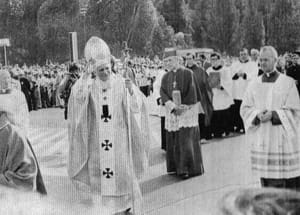
Saint Peter’s Basilica, 11 February 1984
A Good Samaritan is a person who gives the gift of self.
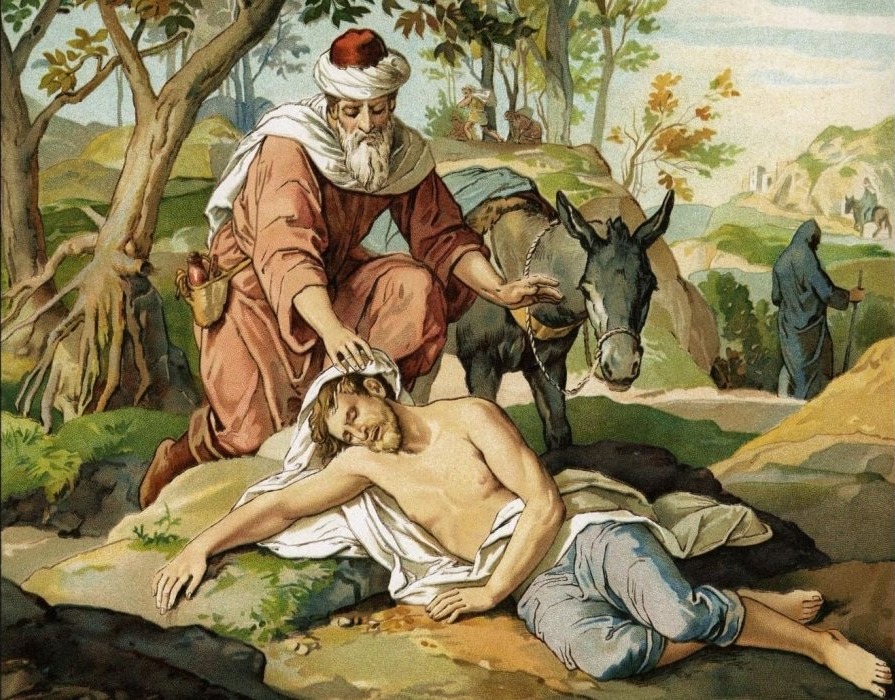
Three travelers along the road from Jerusalem to Jericho saw a half-dead man who had been stripped and beaten by robbers. The Samaritan showed himself to be the authentic “neighbor” of the victim. “Neighbor” also means the person who carried out the commandment of love of neighbor.
Two other men passed along the same road; one was a priest and the other a Levite, but each “saw him and passed by on the other side.” The Samaritan, on the other hand, “saw him and had compassion on him. He went to him, … and bound up his wounds “, then “brought him to an inn, and took care of him” (Luke 10: 33-34).
And when he left, he solicitously entrusted the suffering man to the innkeeper’s care, promising to meet any expenses.
The parable of the Good Samaritan indicates what the relationship of each of us must be towards our suffering neighbor. We are not allowed to “pass by on the other side” indifferently; we must “stop” beside him.
Everyone who stops beside another person’s suffering, whatever form it may take, is a Good Samaritan.
This stopping does not mean curiosity but availability.
It is like opening a particular interior disposition of the heart.
The name “Good Samaritan” fits every individual who is sensitive to the sufferings and misfortunes of others.
If Christ, who knows man’s interior, emphasizes this compassion, it is vital for our whole attitude to others’ suffering. Therefore one must cultivate this sensitivity of heart, which bears witness to compassion towards a suffering person. Sometimes this compassion remains the only or principal expression of our love for and solidarity with the sufferer.
Nevertheless, the Good Samaritan of Christ’s parable does not stop at sympathy and compassion alone. They become, for him, an incentive to actions aimed at bringing help to the injured man. In a word, then, a Good Samaritan gets help in suffering, whatever its nature may be. Service which is, as far as possible, effective. He puts his whole heart into it, nor does he spare material means.
He gives himself his very “I,” opening this “I” to the other person. Here we touch upon one of the critical points of all Christian anthropology. Man cannot “fully find himself except through a sincere gift of himself.”
A Good Samaritan is a person who gives the gift of self.
Excerpted from the writings of Saint Pope John Paul II
Read the original Vatican text
If, in time, you feel moved to support this work, we would be grateful.